
Ideal clients, customer avatars, target audience, ideal customer profile (ICP) – these are all terms for the same thing – but what are they?
Essentially, it’s a clear, detailed description of an imaginary person who is your perfect customer. This description should include demographics, pains, goals, and as much other information as possible.

Why Is It Important to Identify Your Ideal Client?
There’s a well-known saying in marketing: “When you sell to everyone, you sell to no one.” If your messaging is too generic and isn’t written specifically for a particular customer – your ideal client – then it’s likely that it won’t appeal to anyone. Even if you think your products or services could be for anyone, it’s important to be specific and narrow it down as much as possible. You’re not thinking of everyone you could sell to, you’re thinking of who you would love to sell to in an ideal world.
Having an ideal client in mind makes it much easier to keep your messaging clear and it can help you think of content ideas. Ask yourself:
- What would my ideal client be interested in?
- What would they want to know about?
- What would be useful for them?
- How would my products/services benefit them?
Different Types of Ideal Client
It’s common to have more than one ideal client (IC), but it’s best to start with just one and focus on them. Once your first IC is clear and your messaging and tone of voice is established, you can move on to another. It’s best not to have too many, though, as it can get confusing and mix up your messaging – I’d recommend no more than 3.
For example, if you’re an estate agent you might have 3 different ideal clients:
- First time buyers who want to get on the property ladder.
- A middle-aged couple with children who want to upsize.
- An older couple at retirement age who want to downsize.
Each of these clients have very different requirements and so would be interested in very different messaging.
How to Identify Your Ideal Client
When creating your ideal client description it’s important to include as many key details as possible, but at the same time, you don’t need to write an essay!
This is the matrix I ask my clients to complete – it has all the main aspects you need to think about and you can go into as much or as little detail as you’d like for each one. Write something down for each of these areas and really think about them as if they were a real person. If you find this difficult, think of one of your real clients who is exactly the kind of person you want to have as your client, and base it on them, changing details where appropriate.
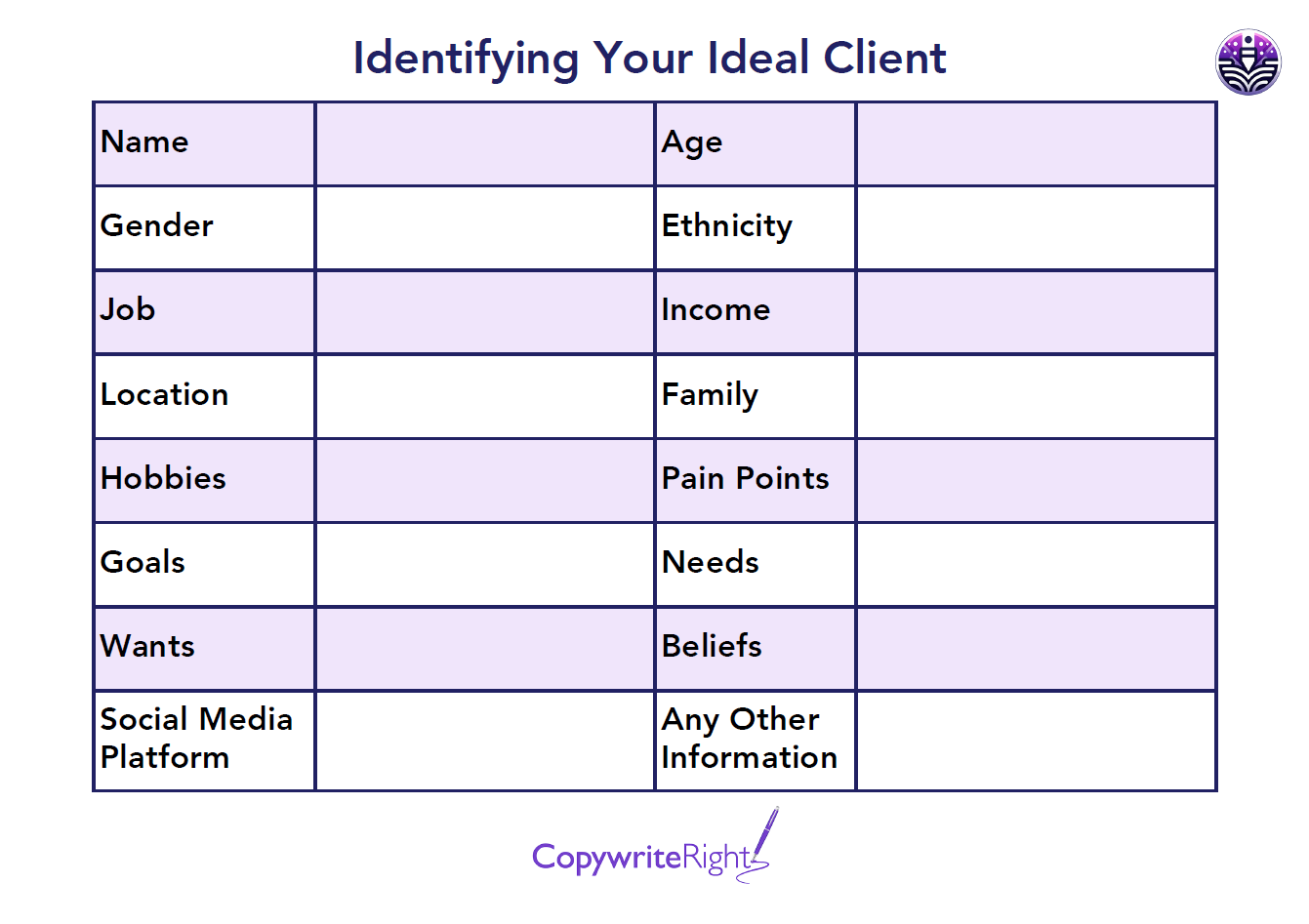
It’s also important to work out which social media platforms – if any – your ideal client hangs out on, as that’s where you need to be sharing your content. There’s no point making videos for TikTok if your ideal client only goes on LinkedIn. Choose one or two platforms where most of your ideal clients are and focus on those. Don’t try to post everywhere; it will take up too much of your time and there’s no point if it’s not where your ideal client will see it.
What Next?
Once you’ve clarified who your ideal client is, use this information to tailor your content. It’s much easier to write when you’re writing to someone, thinking about what they’d be interested in and what they want to know. Going back to our estate agent example, a first time buyer might need to know things like what to look for when viewing a property and how to apply for a mortgage, whilst a middle-aged couple or an older couple about to retire would probably already know those things and would be more interested in other topics.
The next stage is planning your content, which I’ll be writing about next month. You can read about why it’s essential for businesses to have a blog here.
And you can find out more at my next Blogging for Your Business Masterclass – you’ll get everything you need to get started with your business blog and plan 12 months of content.
If you need support with writing or editing, or you’d like more top tips for captivating content, let’s have a chat over a cuppa at a time to suit you.